
Egypt. President Abdel-Fattah El-Sisi inaugurated on Friday the East Nile Monorail project, which extends for 56.5 kilometres covering the distance from Cairo Stadium Station in Nasr City to the Control and Operations Centre in the New Capital.
According to the Egyptian cabinet, the president was accompanied by Prime Minister Mostafa Madbouly and Minister of Transport Kamel Al-Wazir.
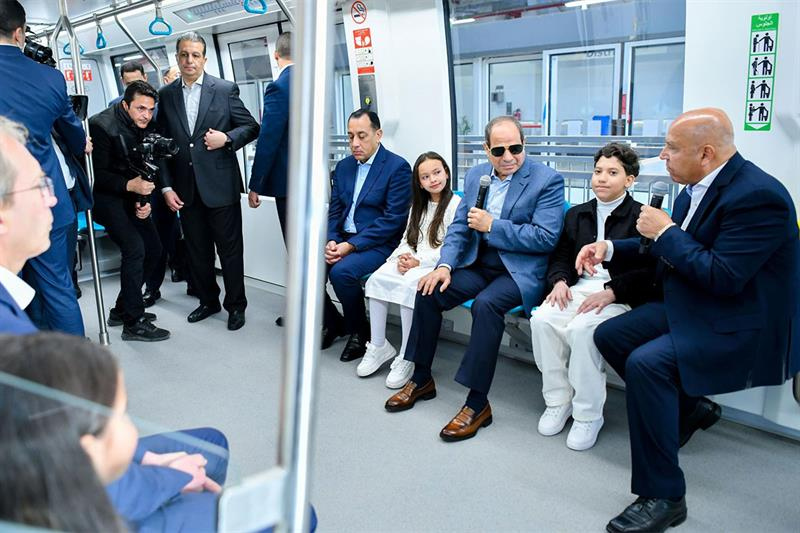
El-Sisi, officials, and families of martyrs took the monorail from Al-Fattah Al-Alim Mosque Station to the Business and Financial District Station. The trip also included passing through R1 and R2 stations in the New Capital.
During the inauguration ceremony, Al-Wazir highlighted that the electric-powered project aligns with presidential directives to expand environmentally friendly mass transit systems.
He said the project aims to develop urban transport by providing a fast, modern, safe, and sustainable means of transportation that improves mobility in Greater Cairo and surrounding areas, linking Nasr City, New Cairo, and the New Capital.
Moreover, Al-Wazir stated that the trains operate on autopilot and that the trip from Cairo Stadium to the New Capital takes around 70 minutes.
According to Al-Wazir, the monorail project has created around 15,000 direct job opportunities in civil, electrical, and mechanical work. It has also created approximately 10,000 indirect job opportunities in related industries and services.
The East Nile Monorail integrates with Metro Line 3 at Cairo Stadium Station in Nasr City and the Light Rail Transit (LRT) at the Arts and Culture City Station in the New Capital. In the future, it will integrate with the second phase of Metro Line 4 at Hesham Barakat Station in Nasr City and with Metro Line 6 at Al-Narges Station in New Cairo, Al-Wazir said.
The system, he added, serves passengers in Cairo Stadium and Al-Azhar University in Nasr City. It also serves schools, universities, major mosques, such as Al-Mosheer Tantawi, Al-Fattah Al-Alim, and Masjid Misr, and hospitals, including Dar Al-Fouad and Air Force Specialized. It also serves major shopping centres, the Business and Financial District, and the Government District in the New Capital. The system would also serve residential communities and clubs.
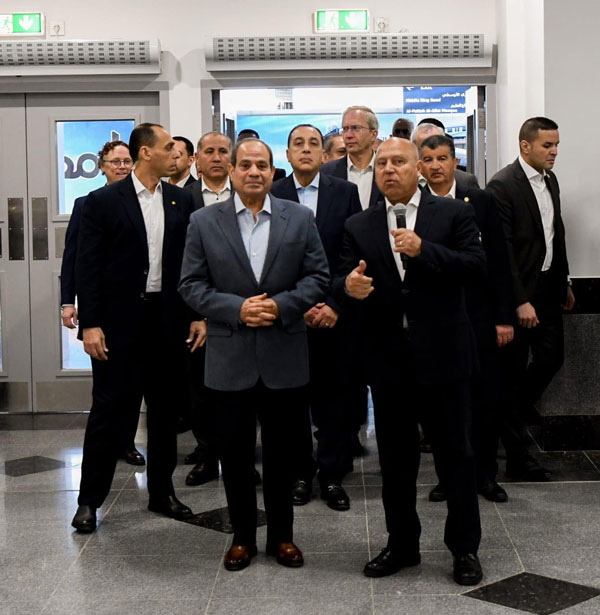
Furthermore, Al-Wazir explained that the project includes 40 trains operating at 80 km/h. Each train consists of four cars to serve urban expansion and increasing daily demand in the New Capital.
He noted that the two monorail lines (East and West Nile) extend for 100 kilometres and include 35 stations each with two levels (ticket hall and platform).
Al-Wazir noted, however, that Cairo Stadium and Al-Azhar University stations include two ticket halls to reduce congestion. In addition, he indicated that the stations are equipped with elevators, escalators, and internal and external stairways. The stations, he stated, have also been provided with designated routes for people with disabilities at both ticket halls and platforms.
Moreover, Al-Wazir pointed out that the project's control and command centre, which includes 13 buildings established on 85 feddans, is located in the New Capital.
Once completed, he affirmed, the system will transport 500,000 passengers per day. The transport ministry, Al-Wazir noted, has also commercially leased naming rights for some stations to private sector companies to increase economic returns.
According to the Egyptian presidency, during the monorail trip, El-Sisi was briefed on the progress of the Green River zone project in the New Capital. The project is expected to host the world's largest central park.
This story was published by ahramonline, you can see the original copy here