
For a long time, Africa’s economic story has been framed around aid. That framing is now outdated.
Across the continent, capital is moving in a different direction. Investment flows are rising, deal activity is accelerating, and more importantly, African capital is beginning to play a far more active role in shaping where that investment goes.
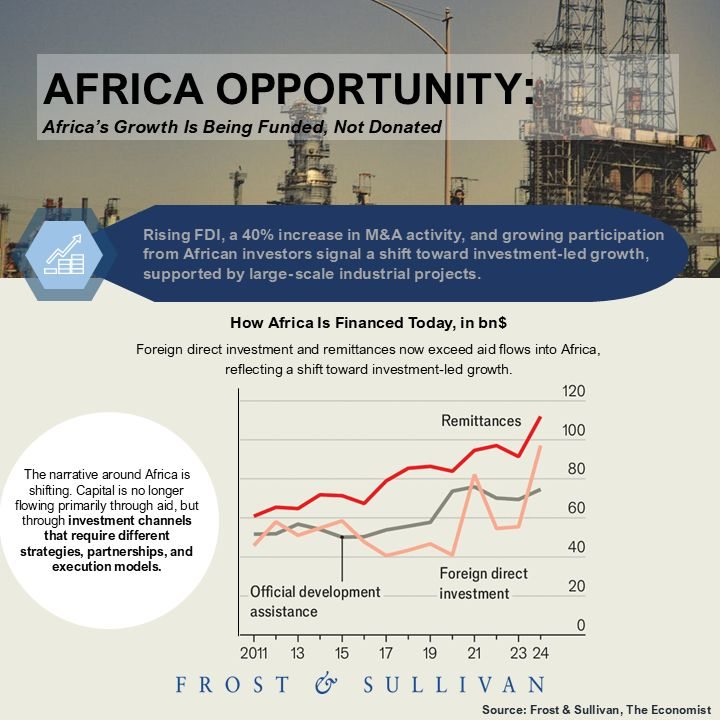
From 2022 to 2024, Africa attracted more greenfield foreign direct investment than Southeast Asia. Venture capital reached roughly $4 billion in 2025, while inbound M&A activity increased by about 40% year on year. Nearly half of the venture capital raised on the continent is now coming from African investors.
In Nigeria, Dangote Group has already deployed over $20 billion into refining and fertiliser capacity and is continuing to expand across sectors and geographies. In Tanzania, projects like the Kabanga nickel development are moving forward on the back of improved infrastructure and coordinated investment. Across the continent, institutions such as the Africa Finance Corporation are expanding their role, deploying billions into rail, energy, and industrial projects structured to attract additional capital.
This change is not limited to the volume of capital, but also its composition. Africa still accounts for roughly 20% of the global population, but only about 3% of global GDP, and receives less than 1% of global private capital. Closing that gap will depend less on concessional funding and more on whether capital can be deployed into bankable, scalable projects.
Certain enabling conditions are taking shape: the African Continental Free Trade Area is expected to increase foreign direct investment by up to 120% as trade barriers fall and markets integrate, cross-border payment systems are reducing friction in intra-African trade, and pension funds and institutional investors are gradually increasing allocations to private markets.
At the same time, infrastructure investment is starting to address long-standing constraints on power, transport, and logistics projects, making resource assets, industrial zones, and urban markets more investable than ever before.
The implication being that Africa’s growth story is no longer defined primarily by capital scarcity, but by the ability to structure, deploy, and scale investment effectively. That changes how opportunities need to be approached. Market entry, partnership models, capital structuring and execution capability are becoming as important as the opportunity itself.
For investors and operators, the question is shifting from “whether to invest in Africa” to “how to deploy capital in a way that actually works on the ground”.