
The European Union’s commitment of €7 billion to accelerate Africa’s renewable energy transition, part of a broader €15.5 billion mobilization, is a watershed moment. Announced in Johannesburg as part of the Global Citizen campaign, this immense capital signals the seriousness of Europe's partnership with Africa to close the energy access gap for 600 million people and advance global climate goals.
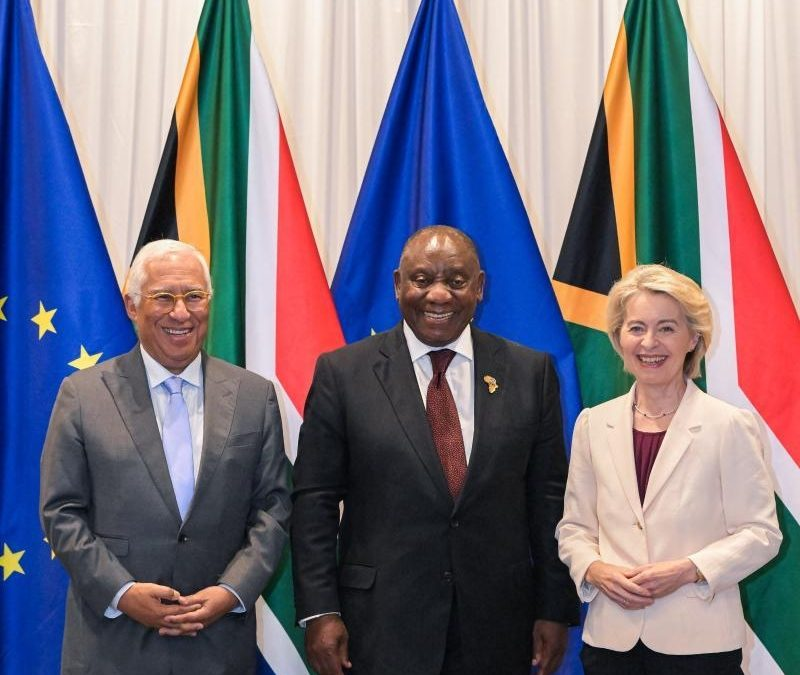 António Costa, Cyril Ramaphosa and Ursula von der Leyen. Source: EC - Audiovisual Service (© European Union, 2025)
This capital is not charity. It is a strategic deployment of blended finance through the EU’s Global Gateway initiative, designed to de-risk large infrastructure projects and mobilize private investment.
The countries that benefit most will be those ready to act as strategic, industrial partners. The race is now on, and two distinct groups of nations are primed to win big.
The Winners' Circle: Industrial Leaders and Green Hydrogen Kings
The highest-impact investment will flow to African nations that can immediately serve Europe’s strategic energy needs, particularly in Green Hydrogen and established clean energy production.
| Top Beneficiary Nations | Why They Will Win | The Strategic Payoff |
| 1. South Africa 🇿🇦 | Policy Readiness & JETP Anchor: Has the strongest grid and established renewable markets. The EU is already heavily invested through the Just Energy Transition Partnership (JETP), making it a reliable destination for financing large-scale solar, wind, and necessary grid upgrades. | Financing will flow fastest here to prove the JETP model and secure the Clean Trade and Investment Partnership recently concluded with the EU. |
| 2. Morocco 🇲🇦 & Mauritania 🇲🇷 | Geographic & Hydrogen Advantage: Both are perfectly positioned in North Africa with immense solar and wind potential. Their proximity makes them ideal candidates for the future Green Hydrogen pipeline networks to Europe (Power-to-X projects). | The funding will be highly strategic, focused on establishing Africa's role as a major Green Hydrogen exporter that is critical to Europe’s decarbonization goals. |
| 3. Kenya 🇰🇪 | Proven Geothermal & Grid Stability: Kenya has a mature, diversified renewable grid (geothermal, wind, solar). The EU has already targeted major funding here for developing its green electricity system and strengthening its transmission network. | Funds will prioritize regional power pool connections and East Africa grid stability, solidifying Kenya's position as a regional power exporter. |
The Access Imperative: Closing the Electrification Gap
While the industrial leaders capture the largest cheques, a significant portion of the €7 billion will be directed toward bridging the severe energy access deficit in high-need, low-electrification countries.
Targeted Nations: Democratic Republic of Congo (DRC), Chad, Niger, and Uganda.
The Focus: In these nations, the funds will support decentralized solutions (mini-grids and off-grid solar) to bring stable electricity to households, schools, and health centres. This is critical for economic inclusion, transforming basic living standards, and fostering small business growth in rural areas.
Africa’s Mandate: Maximizing the Return on Investment
This €7 billion is a catalyst, but it is only one-sixth of the total investment Africa requires by 2030. To convert this initial EU pledge into trillions in sustained private investment, the continent must shift its strategy:
De-Risk and De-Silo: African nations must accelerate market reforms that reduce regulatory uncertainty, standardize power purchase agreements (PPAs), and minimize currency volatility. The EU's funds work best when they act as a guarantee mechanism that pulls in sceptical private capital.
Unify the Grid: The future of African energy is regional. Governments must aggressively push the implementation of the Africa Single Electricity Market (AfSEM) and the Continental Power System Masterplan (CMP). The EU is supporting regional interconnections, which will allow countries with renewable surpluses (like Kenya) to stabilize power in high-demand neighbors (like Uganda and Tanzania).
Build Local Value Chains: The ultimate victory isn't just selling electrons to Europe; it's using those electrons to industrialize at home. We must ensure that Green Hydrogen projects in Namibia or Morocco are tied to local manufacturing—producing green steel or green fertilizers—to create jobs and maximize long-term GDP growth.
The EU's €7 billion is an invitation to African leadership. Our success hinges on our ability to transform financial commitment into strategic capacity, policy clarity, and industrial output. Africa must assert itself as the globe’s indispensable partner for the green transition.