
Did you know Africa now has over 530 million people online, representing nearly 40% of its population? Connectivity is no longer optional. It is shaping how economies grow and how people access opportunity. The continent has more than 77 submarine cables and 2.1 million kilometres of fibre, expanding bandwidth and lowering costs across regions.
MTN Group, with nearly 300 million subscribers, leads alongside Vodacom, Airtel Africa, and Orange, while infrastructure providers such as Helios Towers and IHS Towers are expanding coverage into rural areas. Morocco has 92% internet penetration, and Seychelles leads with 185 mobile subscriptions per 100 people.
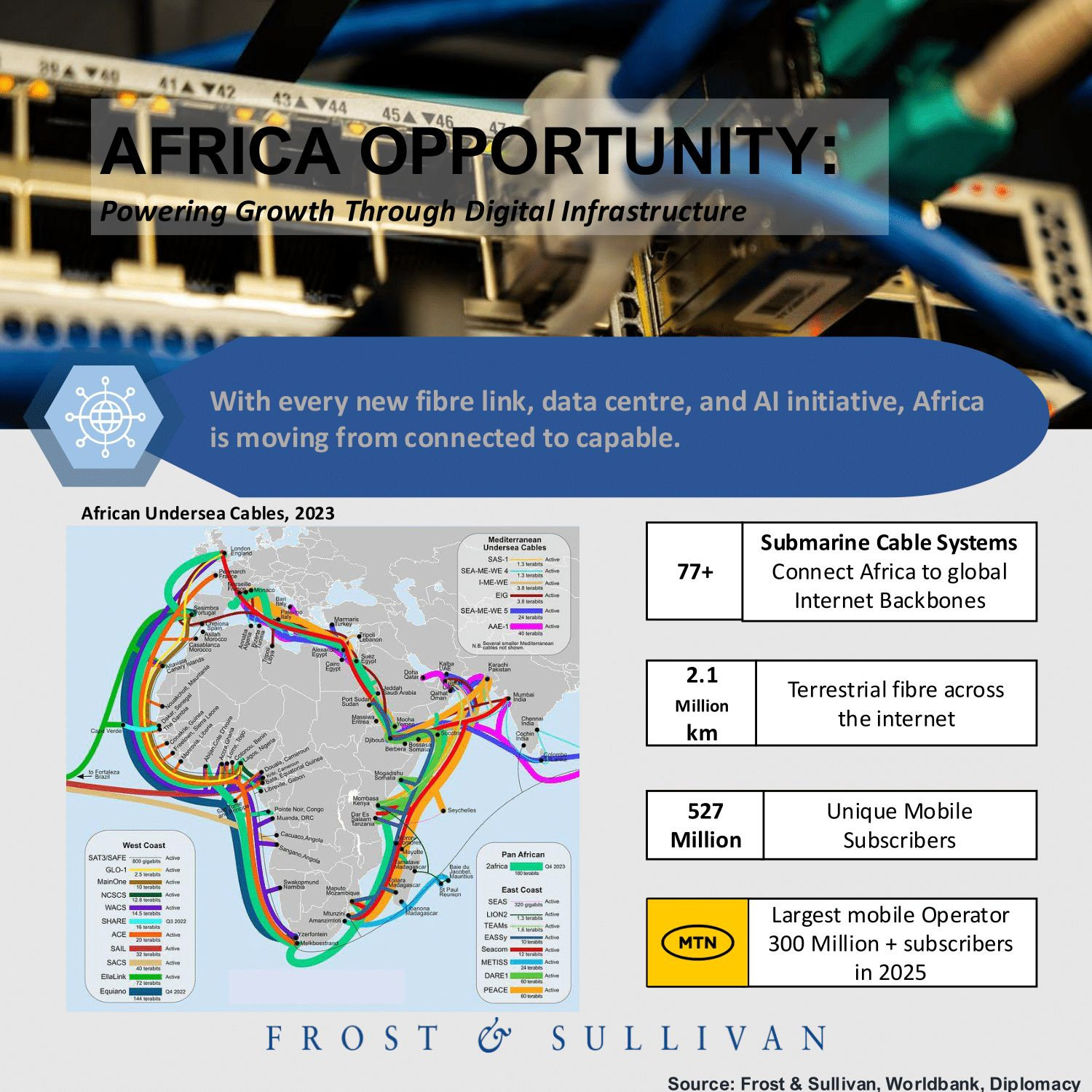
Mobile money, with over 800 million accounts, has transformed financial inclusion. At the same time, data centres and AI infrastructure are strengthening Africa’s digital economy.
In South Africa, Teraco’s expansion of the Cape Town CT2 data centre to 50MW positions the city as a hub for cloud and connectivity, supporting global platforms and local enterprises. In Kenya, Atlancis Technologies’ launch of a GPU-powered AI Factory brings high-performance computing to the region, enabling businesses and researchers to train and deploy AI models locally.
Cross-border collaborations and government digital policies are supporting regional integration and attracting global technology investment. Africa’s connectivity story is one of growth, innovation, and increasing capability. As digital access expands, what could a fully connected Africa mean for its people, economies, and future?
Author